CUSCO CUSCO

MENU


인증 서비스

종합 인증 서비스 및 가이드라인

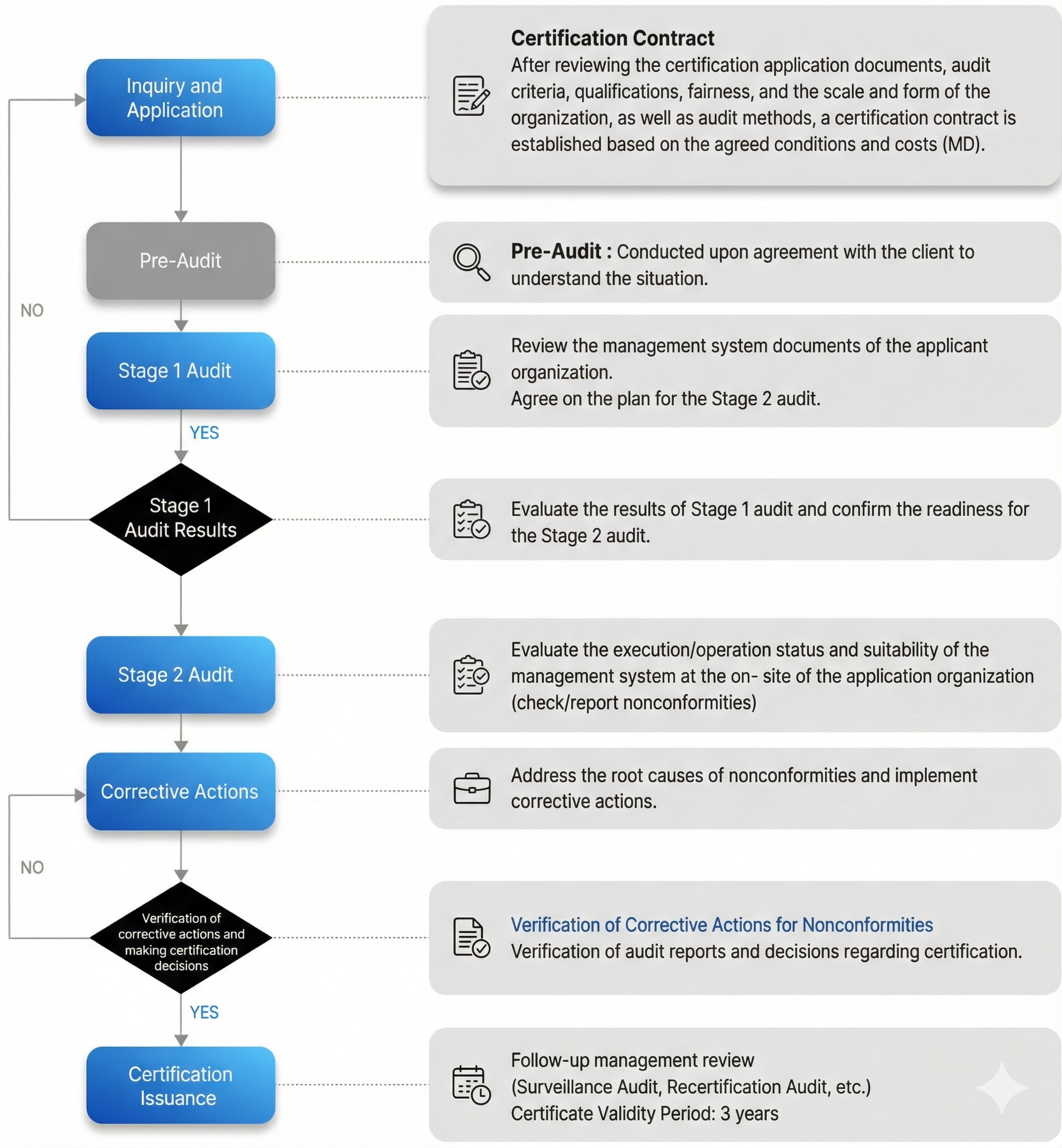
Audit and Certification Process

Audit and Certification Process

Certification Execution Scope (Codes)

KAB SCHEME

ESG-MS Safety
12
Manufacture of Chemicals, Chemical Products, and Chemical Fibers
14
Manufacture of Rubber and Plastic Products
17
Manufacture of Primary Metals and Metal Products
18
Manufacture of Machinery and Equipment
19
Manufacture of Electrical and Optical Equipment
20
Shipbuilding
22
Manufacture of Other Transport Equipment
28
Construction
29
Wholesale and Retail Trade, Repair of Motor Vehicles and Motorcycles, Repair of Personal and Household Goods
31
Transportation, Storage, and Telecommunications
34
Professional, Scientific, and Technical Services
35
Other Services
39
Other Social Services

KAB SCHEME

Quality Environment
03
Food, Beverage, and Tobacco Products Manufacturing
03
Food, Beverage, and Tobacco Products Manufacturing
04
Textiles and Textile Products Manufacturing
04
Textiles and Textile Products Manufacturing
05
Leather and Leather Products Manufacturing
05
Leather and Leather Products Manufacturing
06
Wood and Wood Products Manufacturing
07
Pulp, Paper, and Paper Products Manufacturing
07
Pulp, Paper, and Paper Products Manufacturing
08
Publishing
08
Publishing
09
Printing
09
Printing
12
Chemicals, Chemical Products, and Fibers Manufacturing
12
Chemicals, Chemical Products, and Fibers Manufacturing
14
Rubber and Plastic Products Manufacturing
14
Rubber and Plastic Products Manufacturing
15
Non-metallic Mineral Products Manufacturing
15
Non-metallic Mineral Products Manufacturing
16
Concrete, Cement, Lime, Plaster Manufacturing
16
Concrete, Cement, Lime, Plaster Manufacturing
17/1
Primary Metals Manufacturing
17
Primary Metals and Fabricated Metal Products Manufacturing
17/2
Fabricated Metal Products Manufacturing
18
Machinery and Equipment Manufacturing
18
Machinery and Equipment Manufacturing
19
Electrical and Optical Equipment Manufacturing
19
Electrical and Optical Equipment Manufacturing
20
Shipbuilding
20
Shipbuilding
22
Other Transport Equipment Manufacturing
22
Other Transport Equipment Manufacturing
23
Other Manufacturing
23
Other Manufacturing
24
Recycling
24
Recycling
28
Construction
28
Construction
29/1
Wholesale and Retail Trade
29/1
Wholesale and Retail Trade
29/2
Repair of Motor Vehicles, Motorcycles, Personal and Household Goods
29/2
Repair of Motor Vehicles, Motorcycles, Personal and Household Goods
30
Hotels and Restaurants
30
Hotels and Restaurants
31/1
Transport and Storage
31/1
Transport and Storage
31/2
Communications
31/2
Communications
32
Financial Intermediation, Real Estate, Renting
32
Financial Intermediation, Real Estate, Renting
32/1
Financial, Insurance and Real Estate
33
Information Technology
33
Information Technology
34
Natural Sciences Research and Development
34/1
Professional, Scientific, and Technical Services
35
Other Services
34/2
Humanities and Social Sciences Research and Development
36
Public Administration
35
Other Services
37
Education
36
Public Administration
39
Other Social Services
37
Education
39
Other Social Services
Food Safety
C
Food Manufacturing
03
Manufacture of Food Products and Beverages
E
Catering
04
Manufacture of Textiles and Textile Products
I
Production of Food Packaging Materials
05
Manufacture of Leather and Leather Products
06
Manufacture of Wood and Wood Products
12
Manufacture of Chemicals, Chemical Products, and Chemical Fibers
14
Manufacture of Rubber and Plastic Products
15
Manufacture of Non-metallic Mineral Products
17
Manufacture of Primary Metals and Metal Products
18
Manufacture of Machinery and Equipment
19
Manufacture of Electrical and Optical Equipment
20
Shipbuilding
21
Aerospace
22
Manufacture of Other Transport Equipment
23
Other Manufacturing
28
Construction
29
Wholesale, Retail, Repair of Motor Vehicles, Personal and Household Goods
30
Hospitality, Restaurants, and Pubs
32
Finance, Insurance, Real Estate, and Rental
33
Information Technology
34
Professional, Scientific, and Technical Services
35
Other Services
36
Public Administration
37
Education Services
39
Other Social Services

Audit Days Calculation

ISO 9001 Audit Time Calculation Table

Category Effective Number of Employees Audit Time
(Initial Certification - Stages 1 and 2)
Range Days Range Days
Initial
Certification Audit
1~5 1.5 626~875 12
6~10 2 876~1175 13
11~15 2.5 1176~1550 14
16~25 3 1551~2025 15
26~45 4 2026~2675 16
46~65 5 2676~3450 17
66~85 6 3451~4350 18
86~125 7 4351~5450 19
126~175 8 5451~6800 20
176~275 9 6801~8500 21
276~425 10 8501~10700 22
426~625 11 >10700 23

ISO 14001/45001 Audit Time Calculation Table

Category Effective Number
of Employees
Audit Time
(Initial Certification - Stages 1 and 2)
Effective Number
of Employees
Audit Time
(Initial Certification - Stages 1 and 2)
High Medium Low Limit High Medium Low Limit
Initial
Certification Audit
1~5 3 2.5 2.5 2.5 626~875 17 13 10 6.5
6~10 3.5 3 3 3 876~1175 19 15 11 7
11~15 4.5 3.5 3 3 1176~1550 20 16 12 7.5
16~25 5.5 4.5 3.5 3 1551~2025 21 17 12 8
26~45 7 5.5 4 3 2026~2675 23 18 13 8.5
46~65 8 6 4.5 3.5 2676~3450 25 19 14 9
66~85 9 7 5 3.5 3451~4350 27 20 15 10
86~125 11 8 5.5 4 4351~5450 28 21 16 11
126~175 12 9 6 4.5 5451~6800 30 23 17 12
176~275 13 10 7 5 6801~8500 32 25 19 13
276~425 15 11 8 5.5 8501~10700 34 27 20 14
426~625 16 12 9 6 > 10700 Increase as above

* The audit days calculation table for ISO 14001 / ISO 45001 follows a similar structure but includes additional categories for complexity.

Tips for applying for certification

Hello, thank you for choosing GERMAN CERT. Organizations applying for management system certification with GERMAN CERT should prepare the following documents according to the certification application standards and provide them to our certification body.

  • Documents verifying the duties and responsibilities of the applicant organization
  • Organization chart
  • Address (all addresses where certification is applied for)
  • Representative's profile
  • Standards the organization seeks to be certified against
  • Scope of the management system to be certified (details related to the organization’s management system)
  • General company information (including legal obligations)
  • Detailed description of major tasks and operations of the organization
  • Information related to the applicant organization’s certification, such as manufacturing, resources, assets, services
  • Any other relevant information related to the management system

Initial Stage 1 Audit

The applicant organization must submit the necessary documents and preparations for the Stage 1 audit. The audit is conducted by visiting the applicant organization’s site to ensure compliance. Internal audits and management reviews must have been conducted at least once.

1. ISO 9001: General Requirements for Stage 1 Audit

The following common requirements apply to Stage 1 audits for management systems, including ISO 9001:

Review of Key Processes and System Setup
  • Confirmation of the location and site-specific conditions (evaluation of differences with the application)
  • Review of key processes, objectives, and scope of the management system
  • Verification of the scope of certification applied for (evaluation of differences with the application)
Evaluation of the Management System's Documentation
  • Review of the documentation of the management system
  • Evaluation of the system’s conformity with standard requirements
  • Verification of the system’s implementation status
  • Review of customer requirements and regulatory compliance
  • Evaluation of internal audit and management review results

2. Additional Application Requirements for ISO 14001

  • Environmental Impact Assessment Data: Identification and evaluation of environmental aspects and impacts.
  • Environmental Documentation with Stakeholders: Documents related to the environment with stakeholders (local residents and organizations).
  • Organization's Environmental Management: Matters related to environmental management (flowcharts and descriptions of processes causing water, soil, and air pollution, and waste generation).
  • Details of Environmental Corrective Actions and Non-Conformities: Records of environmental corrective actions and non-conformities.

Initial Stage 2 Audit

The Stage 2 audit is conducted to evaluate the implementation and effectiveness of the applicant organization's management system. The applicant organization must provide the necessary locations, records, and personnel for interviews and site tours. The audit should cover all necessary areas, including verification of conformity, evaluation of implementation, and identification of nonconformities. Relevant personnel, including observers (regulators, accreditation body assessors, technical experts), may attend as necessary.

Audit Preparation

  • Audit site arrangements (meeting rooms, etc.)
  • Preparation of materials (documents, records, etc.)
  • Management system documents (manuals, procedures, records, etc.)
  • Records of the implementation of the audit plan

Opening Meeting

  • Meeting Conduct: Conducted by the audit team leader
  • Participants: Management and relevant staff of the applicant organization
  • Agenda:
    • Introduction of audit team and auditors
    • Confirmation of audit standards, objectives, scope, and criteria
    • Explanation of audit plan, methods, and procedures
    • Overview of audit findings notification (nonconformities, etc.)
    • Designation of guides/escorts, safety/security review, confidentiality, Q&A

Management Interview

  • Participants: Top management, management representative, available personnel, audit team
  • Timing: Prior notice and audit program provided
  • Content: Review of the management system’s performance and management’s commitment

Audit Execution

  • Locations/Scope: Specified locations, relevant departments and personnel
  • Activities: Interviews, on-site review, record checking, sampling
  • Support: Site access and cooperation from relevant personnel

Closing Meeting

  • Conduct: Led by the audit team leader
  • Participants: Management and key personnel of the audited organization
  • Content:
    • Confirmation of scope/criteria, summary of activities
    • Audit findings, nonconformities, and evidence
    • Recommendations for corrective actions
    • Audit conclusion, confidentiality, certification decision, Q&A

Follow-up Management

Surveillance audits do not apply uniformly to all certified organizations. They are determined by the audit team in agreement with the organization based on system maturity, scale, complexity, certification scope, risk, stakeholder opinions, executive period, changes, and previous results.

  • 1st Year Surveillance: Conducted within 12 months from the certification approval date.
  • 2nd Year Surveillance: Conducted annually (3 months before the certification expiry date).
  • 3rd Year Recertification Audit: Must be completed before certification validity expires.

Key Areas of Surveillance Audit

  • Internal Audits and Management Review
  • Actions for Addressing Identified Nonconformities
  • Major Improvements and Continuous Improvement
  • Compliance with Process Requirements and Implementation of Standards
  • Actions to Address Changes
  • Appropriateness of Certification Scope
  • Corrective Actions and Preventive Measures
  • Decision on Further Surveillance Audits
  • Client Requests, Complaints, etc.

Certification Maintenance Criteria

Surveillance audits follow the same principles of determination based on maturity, size, complexity, etc.

* Details of changes can be found in official correspondence or on the website.

  • Maintain the system in compliance with the applicable standards.
  • Always comply with the laws and regulations related to the certification system.
  • Notify GERMAN CERT in case of significant changes:
    - Legal/commercial status, ownership, address, scope
    - Management system/process changes, suspension/closure
    - Bankruptcy, merger/acquisition, environmental accidents (ISO 14001)
    - Loss/damage of certificate requiring reissuance
  • Undergo regular surveillance audits as required.
  • Request special audits if needed: Expansion/reduction of scope, relocation (special audit may be required).
  • Undergo short-notice audits: Complaint verification, lifting suspension, etc.

Suspension and Withdrawal of Certification

Certification may be suspended or withdrawn in the following cases. Upon suspension/withdrawal, all promotional materials referring to the status must be discontinued.

Suspension Criteria

  • Failure to respond to surveillance audits
  • Failure to take action on new standards
  • Violation of mark usage/promotion rules
  • False information/documents
  • Violation of contract
  • Temporary non-application of scope
  • Failure to implement corrective actions

Withdrawal Criteria

  • Failure to reinstate within 6 months of suspension
  • Voluntary withdrawal
  • Suspension > 3 times within validity
  • Bankruptcy/Insolvency
  • Non-application to part of scope requiring withdrawal
  • Severe failure to meet requirements

Renewal Procedure

Certification must be renewed within three years (ISO/IEC 17021). The purpose is to verify:

  • Continuous conformity of the certification system
  • Performance and improvements during the period
  • Contribution to achieving organizational objectives

Certification Promotion Guidelines

For information on the use and promotion of certification marks, please refer to the contents of GERMAN CERT Certification Process 33 (Use of Certification Marks and Certification Marks).
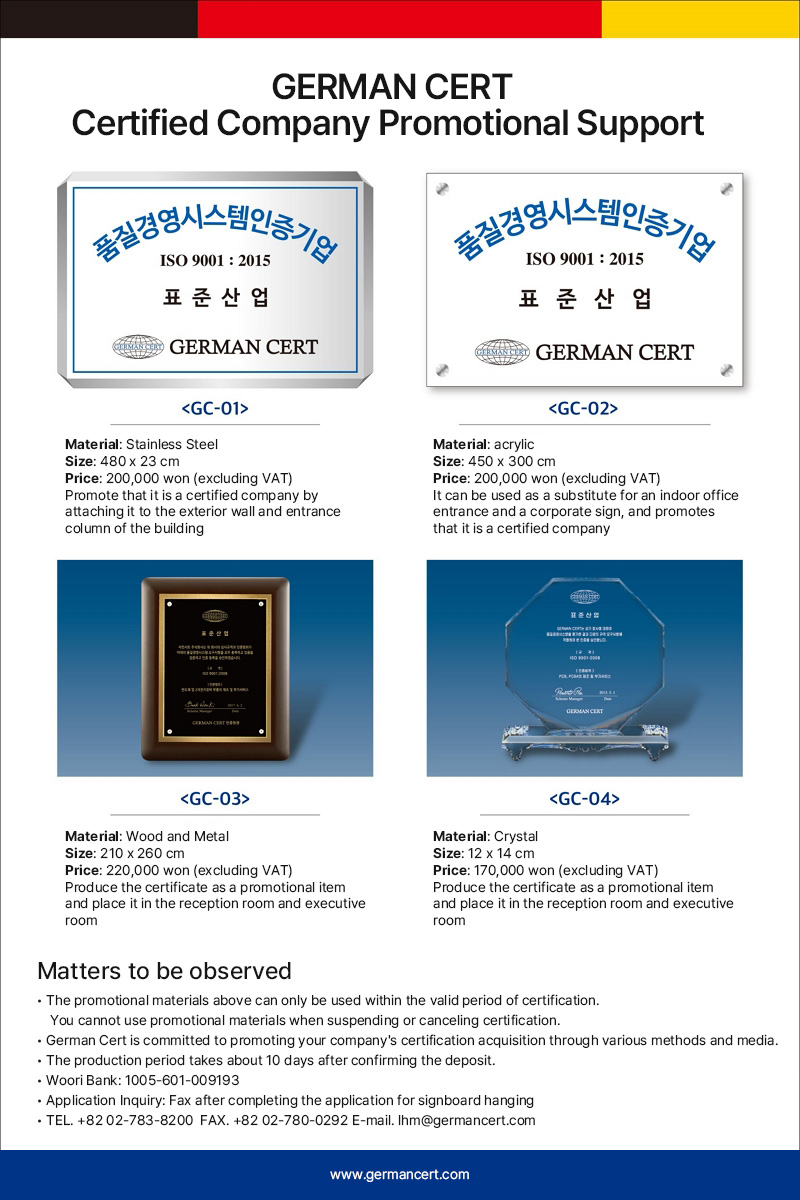
Promotion Sample

Appeals and Complaints

Appeals and Complaints Submission Office Certification Headquarters

Tel.
+82-02-783-8200
Fax.
+82-02-780-0292
E-mail.
gc@germancert.com

Download Action Request

File Download save_alt

* For appeals and complaints, please fill out and submit the request form.
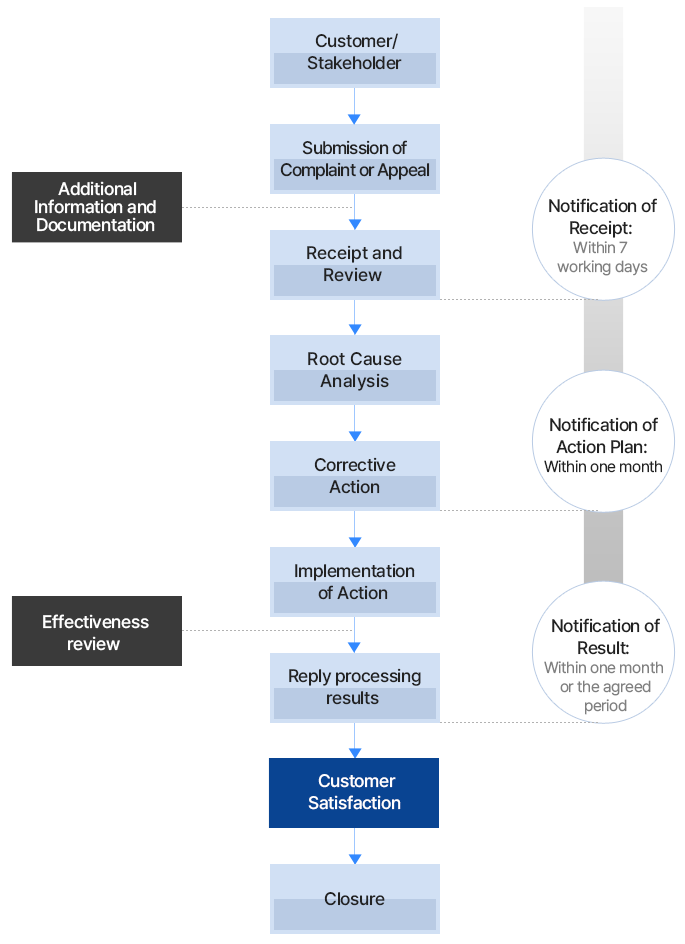
Appeals Process